Artistic sawing with a jigsaw
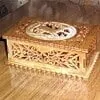
Wood carving has always been a popular craft in ancient Russia. It was used to decorate houses and their interior decoration, and to make various articles and trinkets. All this gave a special flavor to the life of our ancestors. With the advent of hand power tools ...woodcarving... has become more accessible to the masses. This activity can be a wonderful hobby for children and adults, and even bring income. Fortunately, even at school, in labor lessons give an understanding of the basic techniques of woodcarving. 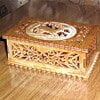
Wood carving is divided into several types
- Through-going. It can be a slotting (done with a chisel or chisel) and a sawing (done with a jigsaw or a saw);
- Flat-edged.
- Three-sided.
- Relief.
- Sculptural.
Jigsaw usage rules and features to consider when doing fine art sawing
- The secure fixation of any work piece is an important rule to ensure the safety and quality of the work.
- The tool must be positioned in the correct position. Only then can the start button be pressed.
- Different jigsaw models may have different ways of securing the saw blade. Therefore, sawing with a jigsaw requires prior study of the user's manual, as the quality and safety of the work depends on the reliability of the saw blade attachment.
- Any state-of-the-art jigsaw will not be able to make absolutely every cut. Some will have to be done manually. Usually jigsaws capabilities are limited to a minimum radius of curvature of 25mm. It is possible to achieve a little more from models with autonomous rotation of the blade. But still, sometimes you will need hand jigsaw..
- If it is necessary to cut in the middle of the part, you must first drill the start and end points. The diameter of the hole is such that the jigsaw blade can be inserted.
- If artistic sawing with the jigsaw is done on a laminated or other delicate surface, then the workpiece must be placed face down and cut from the underside.
- As a material for this type of work it is better to use 3-5 mm plywood - it does not deform when cutting. It is good if you manage to use glued spruce. This material is moisture-resistant, soft to work with, and durable.
Tips for sawing art
Once the pattern is selected, it must be transferred to the workpiece and cut out. If necessary, before this ornament can be scaled with a camera or scanner. Adhere to the following sequence of work:- Before applying the pattern, treat the surface of the material with a sandpaper.
- Fasten the copy paper to the plywood with buttons.
- When a piece consists of several parts, arrange them all on a single sheet of plywood. Make it as compact as possible, and if possible, place the parts as close together as possible. This way you don't have to make extra cuts for each part.
- Use a medium-hard pencil to trace the outlines of the drawings.
- Cut a sheet of marked material into several parts that will be convenient for further work.
- Cut out the drawings from each part.
- Process the resulting parts with emery paper (first coarse, then fine). Do this before joining the parts into the finished product. It is convenient to handle large parts with a sandpaper fixed on a suitable wooden bar.
- After removing the dust after sanding, and connecting the parts, cover the product with varnish.